
LOCATION:
Bukhaweka Vocational Training Centre (BVTC), Bukhaweka, Uganda
Approximately 15 miles (24 km) southeast of Mbale.
COMMUNITY DETAILS:
Since its conception, the BVTC was a response to the needs of the community. The school provided an affordable option for parents unable to pay for other secondary education options. The center served as a community outreach area where the surrounding community members could be tested for HIV/AIDS and receive visual acuity tests and eye care diagnoses.
The BVTC also offered training in carpentry, tailoring, bricklaying, home economics, and agriculture. In the first term of 2007, the BVTC began a computer skills course just up the road at the Christian Rural Eye Sight Promotion (CRESP clinic, which is tapped into the power lines that just came to the village. The CRESP mobile clinic has treated thousands of members of Bukhaweka and surrounding parishes. The relationship between Bukhaweka and CRESP is great as they worked hand in hand towards the welfare of the Bukhaweka and the BVTC. In addition, many community members of all ages have expressed interest in the computer skills course; however, the power lines that recently reached Bukhaweka are extremely unreliable and on days without power the computer students have to return home to work in the fields.
The centre began with 120 students and then enrollment dropped to 80. At the time of the chapter’s assessment trip in 2008, enrollment was down to 30, consisting primarily of women who dropped out of school. The drop in enrollment is due to poverty, with many students lacking the ability to pay fees. Without funds, the school could not pay teachers a consistent salary. Without consistent revenue, teachers could not support themselves and could not always show up to work. Poor teacher attendance led to poor student attendance. The original cost of registration was 45,000 Ugandan Shillings (USh) or $28 per term for three terms per year. The registration fees dropped to 20,000 USh, but students were still unable to pay. The BVTC tried to implement food as a payment method, charging students corn and beans to feed the teachers; however, not all students took it seriously.
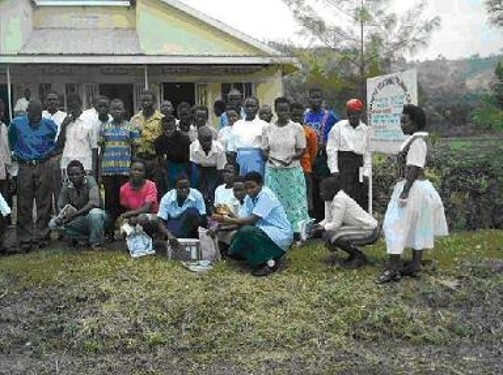
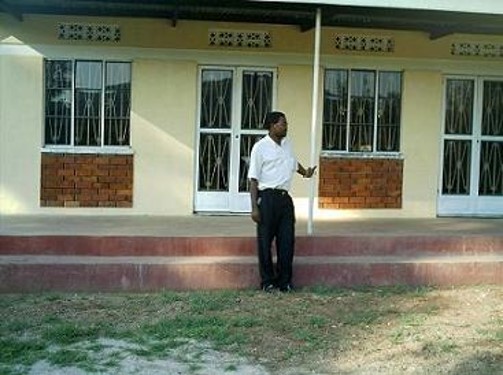
Left: Bukhaweka Vocational Training Centre students Right: Bukhaweka Vocational Training Centre Executive Director Kizito Michael Wabruoko
The exact population is unknown due to the distribution of households throughout the countryside. Approximately 85-90% of the community supports themselves with subsistence farming whereas 10-15% rely on other businesses.
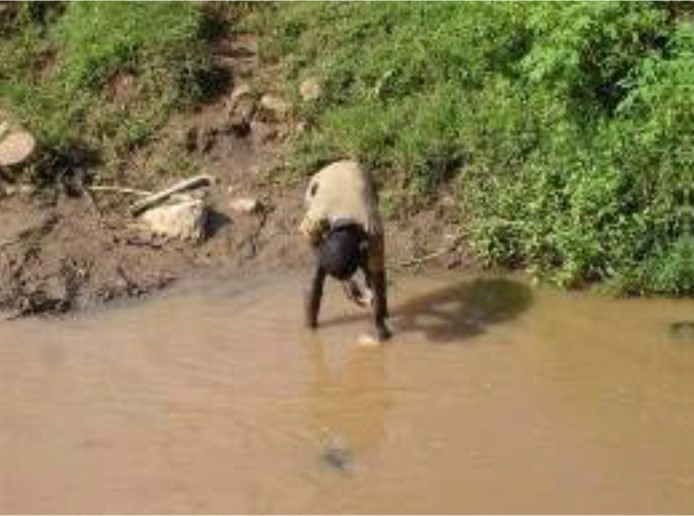
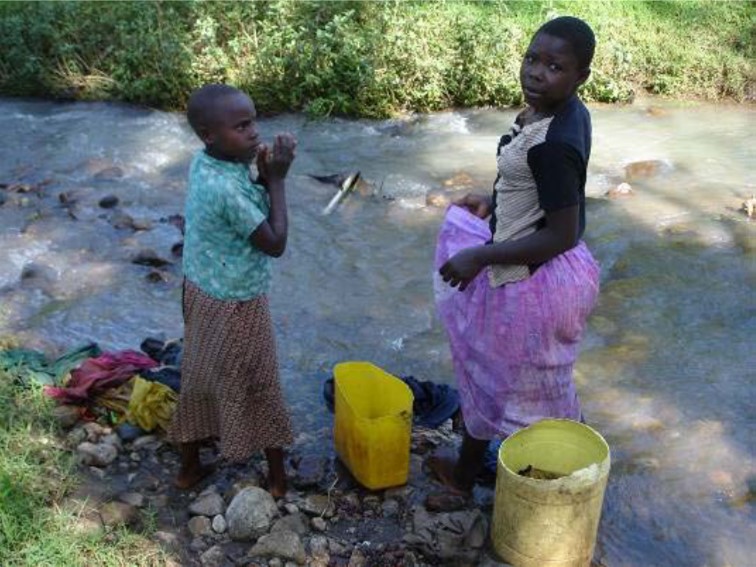
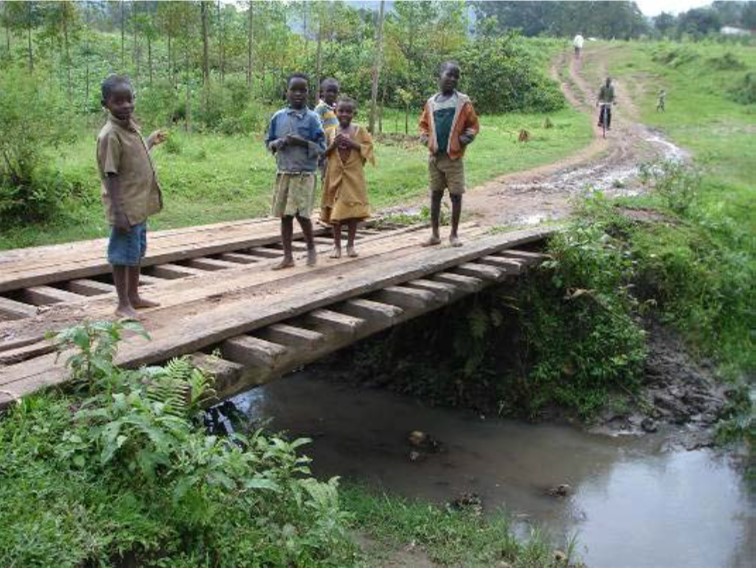
Left: Kufu River near Situmi Primary School. Center: Kufu River near the BVTC. Right: Namabia River near the BVTC.
The residents of Bukhaweka Parish rely on multiple sources of water, including protected springs, traditional water holes, rivers, swamps, and rainwater. Most protected springs are consistently available year round; however, they slow down considerably during December and January and are reportedly a milky color after periods of heavy rain. Rivers, including the Kufu and Namabya rivers, run through the area. They are extremely turbid and contaminated from people and livestock living upstream. River flows decrease significantly from December to March. Rainwater is reliable during the rainy season and many community members already collect it from household barrels or containers. An existing rainwater harvesting system at the vocational center was also supplying water to families from 3 communities living within close proximity (approximately 2,000) until it broke down. At the time there were no boreholes or shallow wells that had been drilled in Bukhaweka Parish or the surrounding area.
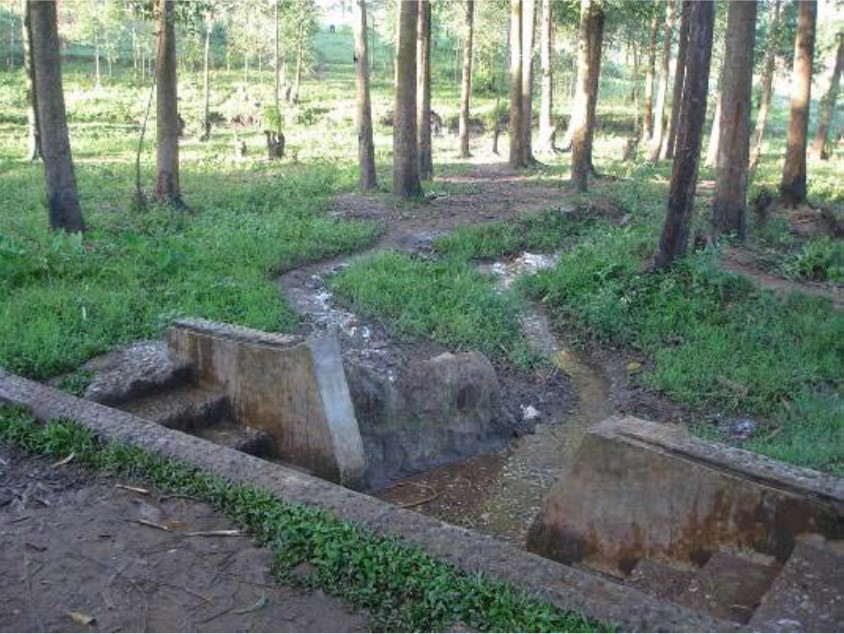
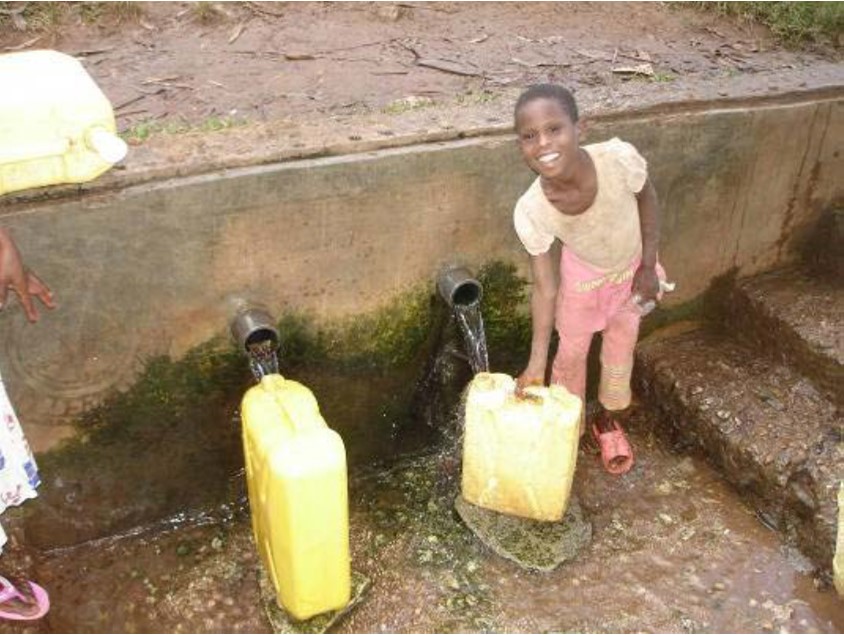
Left: Bukhaweka main spring. Right: Collecting water from the two outlet pipes at the Bukhaweka main spring.
PROJECT SUMMARY:
In rural parts of Uganda, Bukhaweka Parish included, it is common for communities to become complacent with everyday life, with the way they gather water, cook their food, and build and repair their homes. New and innovative approaches to such habitual daily activities often fail to be noticed and embraced, despite their time, energy, money, and environment saving qualities. To address this apathy towards new ideas in the village, the chapter wanted to work to address the most basic human needs and provide cost-effective and environmentally friendly solutions that are directly accessible to people on the ground.
Solutions such as solar power and rainwater harvesting could therefore be made by local people using local materials and their systematic use would help people improve their lives without damaging the environment. Not only would such projects make use of a variety of new and exciting technologies that villagers have never seen before, but it was also a goal of the BVTC that members of the community and students of the school would be trained in these appropriate technologies as construction was carried out. Every aspect of the BVTC’s work involves training local people – disseminating skills that can be used to earn a living.
Kizito Michael Waburoko, an optometrist from the Ugandan community of Bukhaweka requested help in late 2007. As the Executive Director of the BVTC, Kizito sought assistance to provide clean water and electricity for his community and students. In his words, “Water is life. Without knowledge in computers you are cut off from the rest of the world. Kindly try to help the centre with the above two projects.”
Water and power supply and continued education were the current priorities of the BVTC. The BVTC Board and the chapter determined that well water and rainwater were the best methods for solving the water scarcity and water contamination problems. To solve the power supply issues, they considered both solar power and a battery bank to store energy from the nearby power lines. By the end of the 2008 assessment trip, it was determined that solar power was the more feasible power supply option.
In July 2009, a 10-inch diameter borehole was drilled in the overburden to a depth of 28 meters, with a 4 ½-inch hole drilled to 33 meters in the bedrock. The borehole was capped and a manual U3M deep well pump was installed. The U3M is a Ugandan version of the India Mark II pump, a piston pump that provides a capacity of 12 liters/minute at a depth of 45 meters. It was developed by UNICEF and is very common in East Africa. The U3M operates in the same manner as the India Mark II and is more resistant to corrosion. A concrete pad and protective fence were installed at the site.
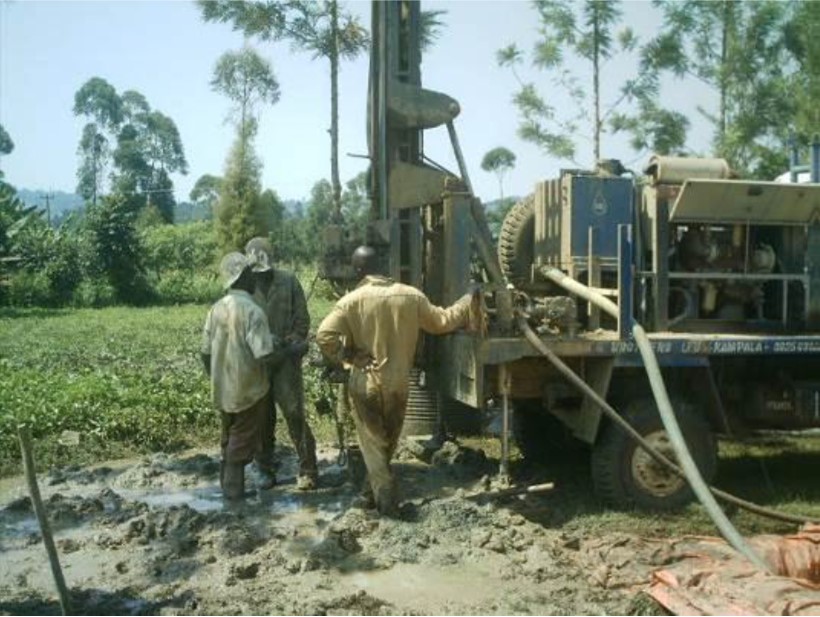
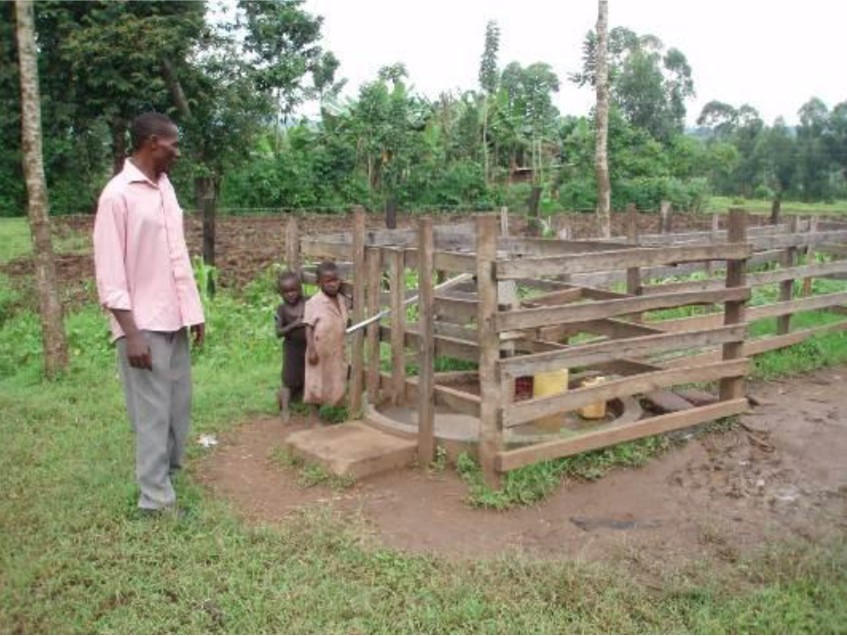
Left: Drilling of borehole in 2009. Right: Completed borehole mounted with U3M handpump and concrete pad & protective fence.

Celebration at the completion of the new borehole and handpump, pre-installation of the security fence.
In December 2009 installation was completed a solar-powered electrical system capable of powering eight lights and two computers. It used two 150 W PV panels wired in parallel. A 30 A charge controller regulated the power flowing to the batteries, and a 700 W inverter was attached to the two 100 A-hr batteries that were connected in parallel. The lights were each wired with a local switch to allow the users to turn them on or off.
However, the system’s inverter failed in April of 2010, five months after installation. The BVTC returned it to the supplier and was waiting for a new inverter. As of last known information, a new inverter was not received. A second failure occurred in May 2010 when several of the lights stopped functioning. The theory is that rats in the attic chewed through the connecting wires, however, this was not verified or troubleshooted to see if it was indeed due to rats or due to a poor connection.
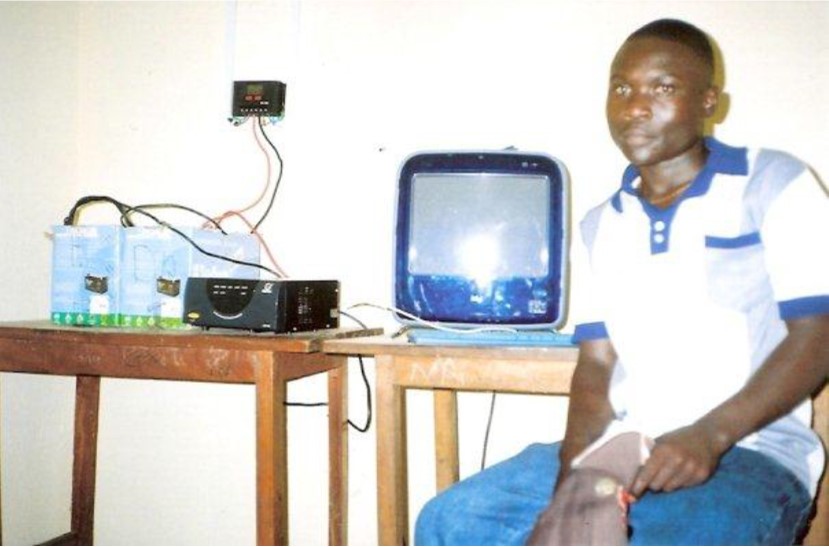
300 W solar-powered system which powered 2 computers and 8 lights.
During a May 2010 implementation trip multiple projects were carried out to completion within the area.
First the team worked on two rainwater harvesting projects in Bukhaweka Parish: 1) Team members repaired an existing rainwater harvesting system and then modified it to include a first flush; 2) At a different site team members installed a second rainwater collection system along with a water storage tank.
The existing tank at the BVTC had not been in use because of a broken tap. The existing rainwater harvesting system at the BVTC also did not include a first flush. Without the first flush, contaminants on the roof were washed straight into the water storage tank. A first flush would provide the ability to flush the roof with the rainwater before cleaner water would be collected and stored in the tank. The team decided to repair a number of deficiencies.
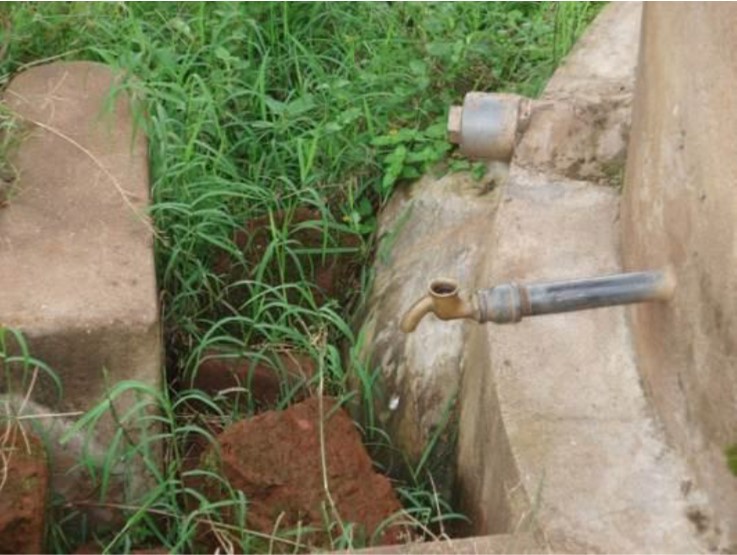
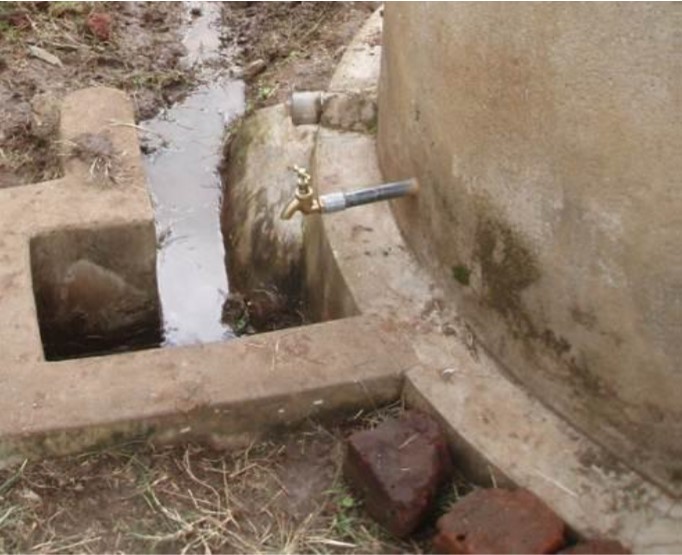
Left: Broken water spigot at existing rainwater harvesting system. Right: Repair of spigot.
The gutters, which had not been installed at a correct slope, were holding stagnant water. Several gutters were removed and reinstalled the gutters at a 0.5% slope. Stagnant water in the tank was drained. The broken tap was replaced with a larger, more durable tap and the area around it was cleaned to allow for water to drain away and prevent the breeding of disease vectors. The team installed a first flush system with 4-inch diameter PVC running the height of the building. The first flush volume satisfied the design criteria of 45 liters per 100 square meters of catchment area plus an additional safety factor, as barriers were placed around the first flush pipe and tap to prevent vandalism.
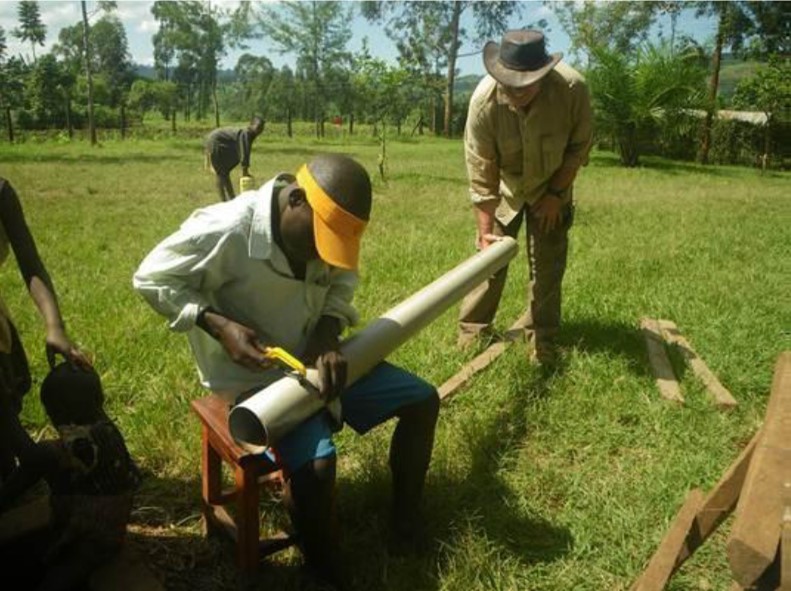

Left: Construction of first flush system. Right: Completed modifications of existing rainwater system.
During the same May 2010 implementation trip, the second rainwater harvesting system was an impromptu decision made by the chapter to construct a 2nd rainwater harvesting system at the Kitongo Health Clinic. The clinic is close to the populated BVTC. It also lies along the path to Masaka Primary School. This area was dependent on river and spring water. The rainwater system would provide an additional drinking water source for people living nearby. The new installation utilized both sides of the health center’s corrugated metal roof. Large cross-section gutters were installed running the length of the building, about 17 meters. Gutters were installed with a gradual slope (< 0.5%) towards the 4-inch diameter plastic pipe downspouts . On each side, the water runs through a system of plastic piping to a simple “first flush” capture system and on to the final storage tank
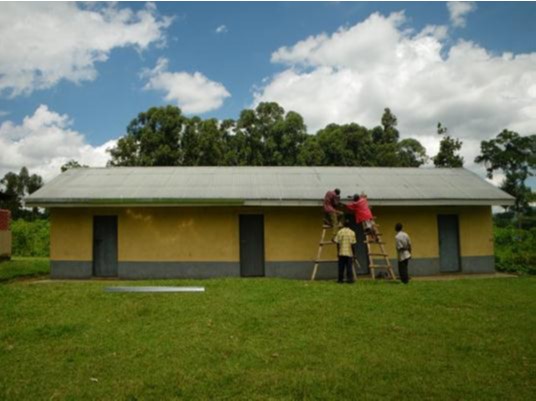
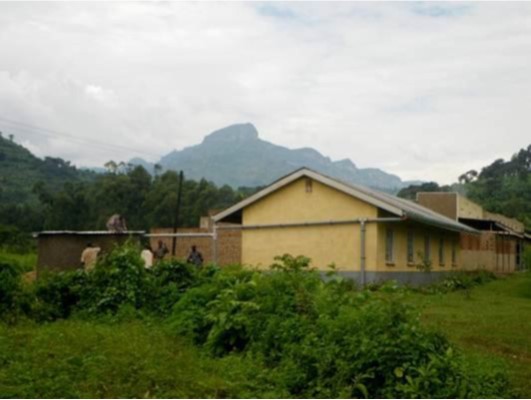
Left: Local Ugandans installing the new rainwater harvesting system on Kitongo Health Clinic. Right: The completed rainwater harvesting system.
Following completion of the new gutters and first flush system, the team and locals constructed a 13,000 liter tank at the site to store water collected by the new rainwater harvesting system.
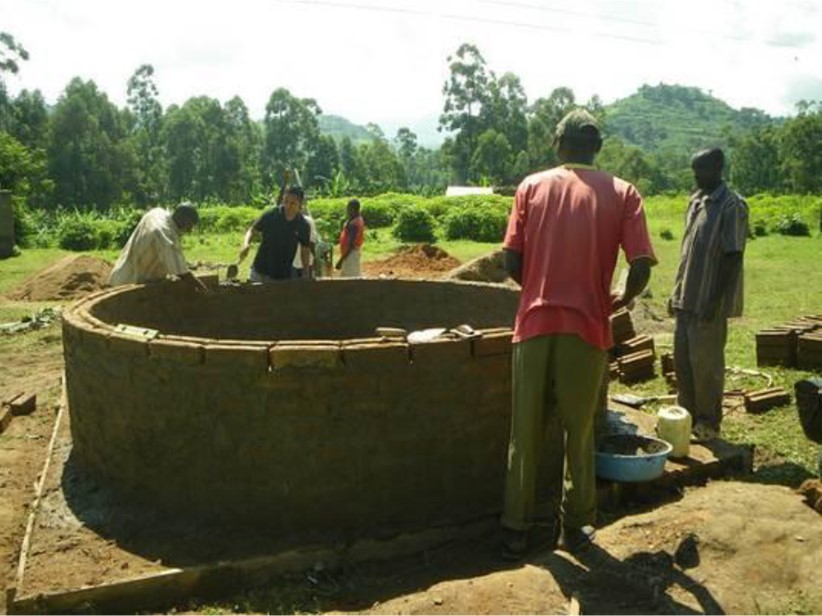
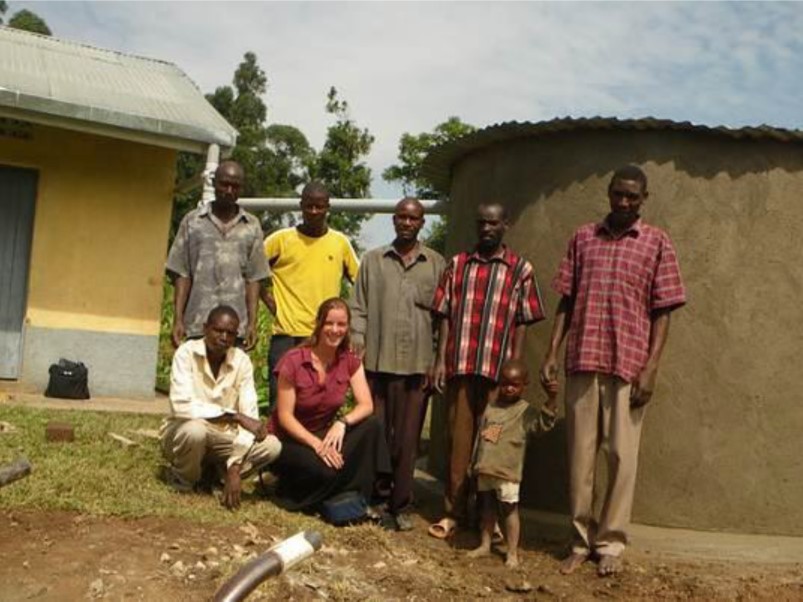
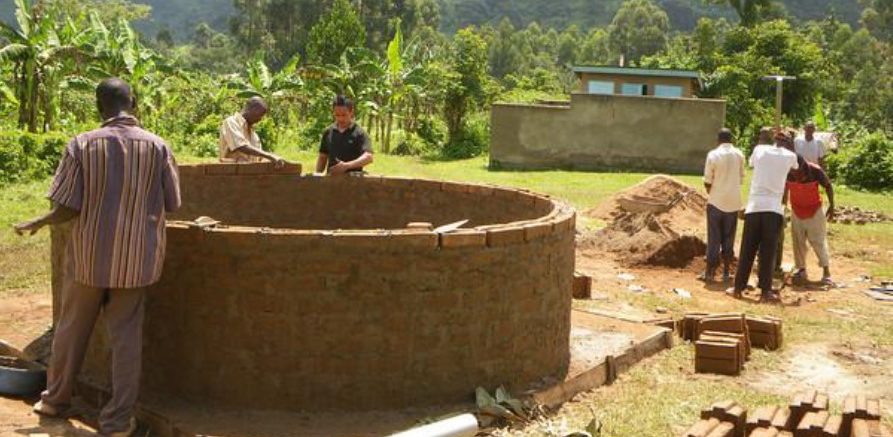
Left: Construction of the 3-meter diameter tank from bricks created nearby. Right: The completed 1.9-meter high collection tank.
Residents of Bukhaweka indicated they would drink from the cleanest source within a reasonable distance of their homes. Most people who live near the trading center walk to the spring nearby Bukhaweka main spring. Even though the borehole water is cleaner, they won’t walk a farther distance to collect the well water. Only the families who live near the borehole use it (unless other sources dry up). Additionally, the chapter discovered after returning from the 2008 assessment trip that people living near the BVTC were choosing rainwater over well water. Although the well water is much cleaner, the rainwater is easier to collect by turning a tap instead of pumping.
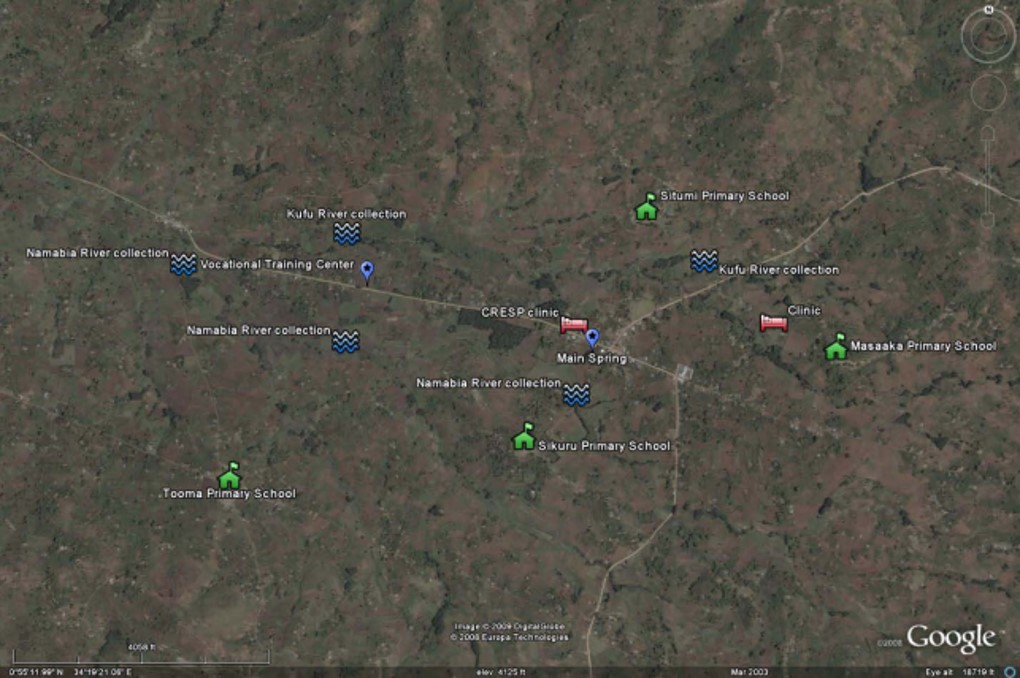
Regional points of interest and nearby water sources.
In many cases, water quantity was more important to community members than quality. The springs seem to provide excellent quantity and sufficient quality. Although the main spring contained a concentration of 400 total coliforms/100 mL, the Bukhaweka community seems to have developed a strong immunity to it from growing up there. Few people complained of diarrheal diseases; malaria was the bigger killer. Therefore, it seems more important to protect multiple springs for a more economical cost than to drill boreholes. Therefore, the chapter decided to fund the construction of three protected springs in Namabya Subcounty.
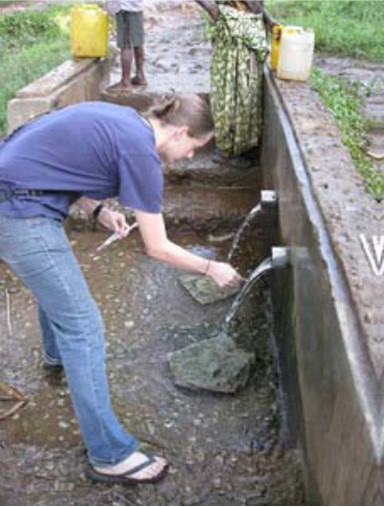
Collecting water at the Bukhaweka main spring for water quality testing.
With this information in mind, some of the last work the chapter set to complete during the May 2010 implementation trip was development to protect several local springs.
People living near Sikela were tired of waiting for the government to improve their community: instead of waiting for a professional spring, they handmade one themselves. However, their spring yielded very little water. The chapter planned construction of a new protected spring uphill from the existing site where the flow was much greater.
Ugandans living nearby completed the excavation for the new site. The chapter arranged for the transportation of the sand, aggregate, and large concrete blocks; however, since the road conditions leading up to the area were bad, the cement and large blocks were dropped off over half a mile from the spring. Shortly afterward, a train of local Ugandans came down the road carrying the concrete blocks and 100-lb bags of cement on their heads. It was truly an amazing sight.
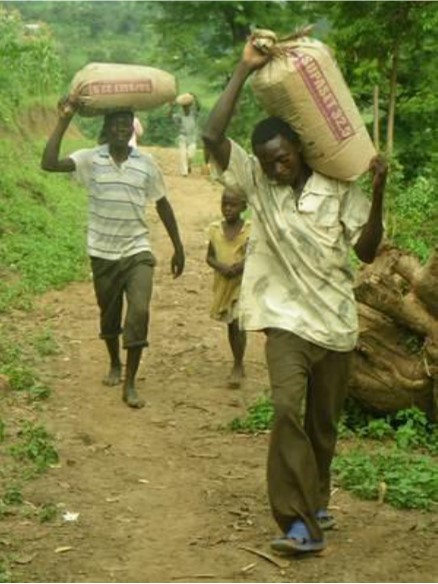
Community members carrying bags of cement over half a mile to the spring construction site.
The spring’s wall and staircase had already been constructed and community members continued to excavate behind the wall. A drainage ditch was dug to provide a path for the water to flow. The residents of Sikela backfilled the area with large and small stones, called “hardcore”, which act as a natural water filter. One of the most challenging parts of the build was threading the 2-inch PVC pipe through a 2-inch metal pipe in the wall. The eight-foot long PVC pipe transports water form the site of the spring to its output at the wall. It’s held securely in the 2-inch metal pipe that goes through the wall itself. However, the PVC was slightly larger and they could not thread it through. They quickly created a fire from a nearby pile of leaves, burned the PVC, and jammed it in the metal pipe. This worked on the third attempt. The stones were covered with polyethylene paper, which was then buried under a layer of mud. The protect spring was then ready for use!
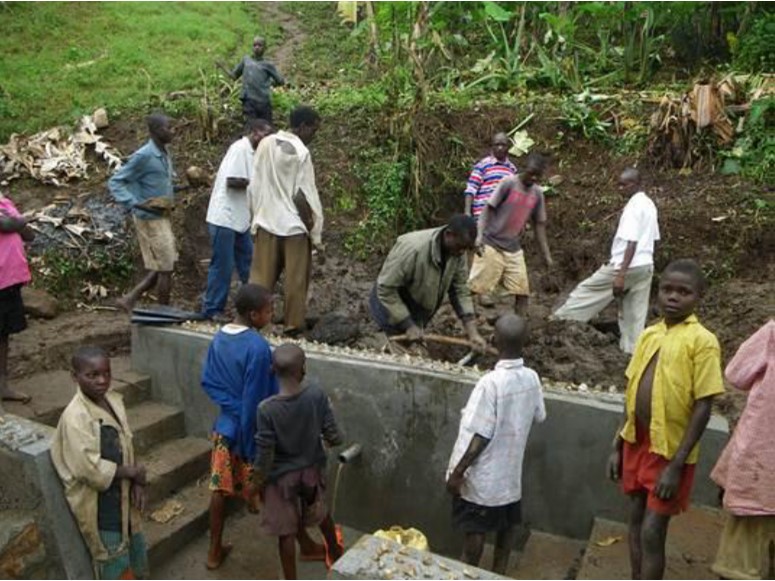
Sikela community members leading construction of the infrastructure to protect the local spring source.
The other spring source refurbished were two springs in the community of Namirama, called Mutsemwa and Nakhele. The project was not completed during the implementation trip, but was completed by the team remotely following their departure.
The project was closed out in 2011. The team was unable to confirm community support for any additional project phases or monitoring of prior construction. In part, the lack of communication was due to the team’s original NGO, the primary contact with the community, moving from the Bukhaweka community.
Through subsequent correspondence with the team’s original NGO, the chapter was informed that the BVTC was forced to close because the community ran out of funding for teachers’ salaries. While the original NGO continued for several months to try to find an additional viable engineering project in the area, none were forthcoming.
Repeated attempts were made to contact the community through other contacts identified during the first phase of work to identify an additional phase project, to find another NGO in the community, and to ascertain that whether initial phase infrastructure was functioning. The chapter did not receive responses to the attempts and other attempts to find another on-ground NGO were unsuccessful. After these extended and reasonable efforts were made, the project was closed.
PROJECT ADOPTION DATE:
2007 (Central Houston Professional Chapter)
PROJECT STATUS:
Complete
Impact: 2000 people provided with clean water via well and rain catchment system
TEAM LEADS:
- Sara Beck
- Howard Speight
- Kim Chanslor
- Nancy Kralik
- Arci Martinez